


Sedona sits in the high desert of northern Arizona, about two hours north of Phoenix. The town is known for its red sandstone rock formations, its hiking trails, and its reputation as a center for spiritual energy sites called vortexes. If you are planning a trip to Sedona in 2026, this guide covers what has changed this year, when to go, how to get there, and what to see once you arrive.
Quick Facts: Sedona at a Glance
| Category | Details |
|---|---|
| Location | Verde Valley, northern Arizona, about 115–120 miles north of Phoenix |
| Elevation | Around 4,300–4,500 feet |
| Best time to visit | March–May and September–November |
| Nearest airports | Flagstaff Pulliam (FLG), about 30 miles away; Phoenix Sky Harbor (PHX), about 2 hours away |
| Trail parking permit | Red Rock Pass — $5 (day), $15 (7 days), $20 (year) |
| Estimated daily budget (2 people) | About $95–170/day budget, $205–345/day mid-range, $455–745/day luxury (estimated, as of 2026) |
| Known for | Red rock formations, vortex hikes, Oak Creek Canyon, art galleries |
A 2026 Update Worth Knowing Before You Pack
If you are researching this trip in September 2026, there is one thing you should check before you finalize your plans: the Pocket Fire. The wildfire started north of Sedona in June 2026 and burned around 27,000 acres in the Oak Creek Canyon area before firefighters reached full containment in late July. The fire itself is out, and Sedona is open and operating normally, including State Route 89A.
However, the burn scar left behind a flash-flood risk in the watershed, so a few specific spots remain closed as a safety precaution. As of the most recent update, the West Fork Trail, the Oak Creek swimming area at Slide Rock State Park, and a handful of smaller trails (including Dry Creek, Secret Canyon, and Bear Sign) are closed through the end of September 2026, tied to the monsoon season’s flood risk. Most of Sedona’s best-known hikes, including Devil’s Bridge, Cathedral Rock, Bell Rock, Boynton Canyon, and Soldier Pass, have already reopened. Slide Rock State Park itself is open for hiking, picnicking, and vehicle access, just not swimming in the creek.
Because these closures are tied to a specific expiration date rather than being permanent, always check the Coconino National Forest alerts page or the Red Rock Ranger District (928-203-2900) close to your travel date rather than relying on any single article, this one included.
Best Time to Visit Sedona
Spring (March to May) and fall (September to November) are the two most popular windows to visit. Both bring mild daytime temperatures, generally in the 60s to low 80s Fahrenheit, which makes hiking comfortable. Spring adds wildflowers to the landscape, while fall brings cooler mornings and some color change along Oak Creek Canyon, especially from mid-October.
Summer (June to August) is hot, with daytime highs often in the 90s and afternoon monsoon storms that can trigger flash flooding, which is exactly what has kept some Oak Creek trails closed this year. If you visit in summer, plan hikes for early morning and treat any creek crossing with extra caution.
Winter (December to February) is the quietest and cheapest season. Temperatures are cooler, and the red rocks occasionally get a light dusting of snow, which many photographers consider one of the best sights in the region. Trails stay open, though some can be muddy or icy after storms.
Getting to Sedona
Sedona does not have a commercial airport. There is a small general aviation airport on Airport Mesa, but it only serves private and charter flights.
Most travelers fly into one of two airports:
- Flagstaff Pulliam Airport (FLG) is the closer option, about 30 miles and roughly 40–50 minutes away by car, partly through the scenic Oak Creek Canyon on Highway 89A. It has fewer flight options, mainly connecting through Phoenix, Denver, Dallas, and Los Angeles.
- Phoenix Sky Harbor International Airport (PHX) is a major hub with far more flight choices, but it’s about a two-hour drive away via Interstate 17 and State Route 179.
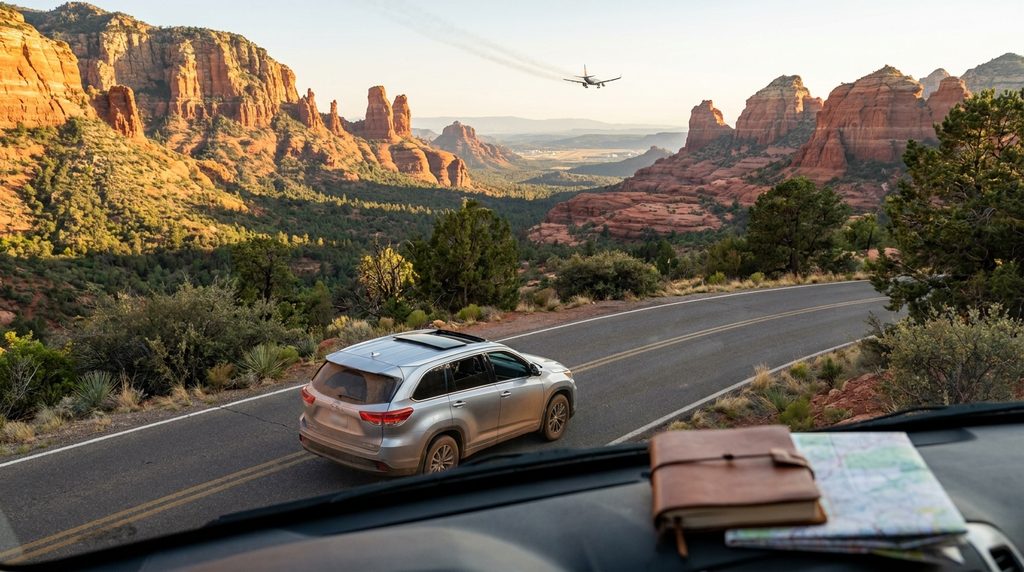
Renting a car is the most practical option once you land, since Sedona’s attractions and trailheads are spread out and public transit between cities is limited. If you’d rather not drive the mountain roads yourself, private shuttle services also run between both airports and Sedona hotels.
Top Things to See and Do
Hike the vortex sites. Sedona is best known for four energy vortex locations — Cathedral Rock, Bell Rock, Airport Mesa, and Boynton Canyon. Believers describe each one as having a different kind of energy, while skeptics still find them worth the walk simply for the views. Cathedral Rock is the most physically demanding of the four, with some scrambling near the top, while Bell Rock and Airport Mesa are easier and more accessible.
Walk across Devil’s Bridge. This is Sedona’s largest natural sandstone arch and one of the most photographed spots in the region. The hike to it is moderate, and lines can form at the top for photos, so an early start is worth it.
Drive or hike through Oak Creek Canyon. This scenic corridor along Highway 89A connects Sedona to Flagstaff and is lined with pine forest, red rock walls, and creekside picnic spots. Some sections of the West Fork Trail remain closed this year (see the update above), but the scenic drive itself is open.
Browse Tlaquepaque Arts & Crafts Village. This outdoor shopping center, built to resemble a traditional Mexican village, is filled with galleries, boutiques, and cafés, and is a good option for travelers who want a slower day away from the trails.
Take a Jeep tour or hot air balloon ride. Several local operators run off-road Jeep tours into the backcountry, and sunrise balloon rides are popular for seeing the red rocks from above before the day heats up.
Visit Red Rock State Park. Located on the western edge of town, this state park has gentler trails along Oak Creek, making it a good choice for families or anyone looking for an easier walk with strong scenery.
Practical Planning Notes
You’ll likely need a parking pass. Most trailheads on National Forest land require a Red Rock Pass, which costs $5 for a day, $15 for a week, or $20 for a year. It’s sold at trailhead machines, the visitor center, and some local stores. Stops under 15 minutes, such as a quick photo, don’t require one. An America the Beautiful national park pass also works in its place.
Budget realistically. Sedona markets itself as a premium destination, and prices reflect that, especially at hotels close to Uptown. Estimated 2026 per-person daily costs (assuming two people sharing a room) run roughly $95–170 for a budget trip, $205–345 for mid-range comfort, and $455–745 for a luxury stay. These are estimated figures and will vary by season and how far in advance you book.
Consider where you stay. Uptown Sedona puts you closest to shopping and restaurants but is also the busiest and priciest area. West Sedona tends to have more affordable lodging with easy highway access to trailheads. The Village of Oak Creek, south of town, is quieter and closer to Bell Rock and Cathedral Rock.
How This Was Researched
I researched this guide using official sources, including City of Sedona news releases, the Coconino National Forest and Arizona State Parks alert pages, and current visitor information from Sedona’s tourism and lodging sites, cross-checked against independent travel guides. Where I found conflicting or unconfirmed figures, such as exact 2026 crowd numbers, I labeled them as estimates rather than presenting them as fact. Many older Sedona guides online don’t reflect the trail and swim-area closures tied to this summer’s Pocket Fire, which is the main gap this article tries to close.
Frequently Asked Questions
Is Sedona open to visit right now?
Yes. Sedona is operating normally, and the main highways in and out of town are open. A small number of trails and the Slide Rock swimming area remain closed through the end of September 2026 because of flash-flood risk from this summer’s Pocket Fire burn scar.
Do I need a permit to hike in Sedona?
Most trailheads on National Forest land require a Red Rock Pass, which costs $5 per day, $15 per week, or $20 per year. An America the Beautiful pass also works.
What is the closest airport to Sedona?
Flagstaff Pulliam Airport is the closest, about 30 miles away, though it has limited flights. Phoenix Sky Harbor is a larger airport with more options, about a two-hour drive from Sedona.
Are the Sedona vortexes real?
This is a matter of belief rather than something that can be scientifically confirmed. The four sites most associated with vortex energy — Cathedral Rock, Bell Rock, Airport Mesa, and Boynton Canyon — are also simply excellent hikes with strong views, regardless of what a visitor believes about the energy claims.
How many days do I need in Sedona?
Two to three full days is enough to cover the main hikes, a scenic drive, and some time in town. Longer stays make sense if you want to add day trips to the Grand Canyon or Flagstaff.
Accuracy Note
This article is based on publicly available information from official government and tourism sources, along with independent travel guides current as of September 2026. Trail and park closures can change quickly, so please verify current conditions directly with the Coconino National Forest or Visit Sedona before you travel. If you spot anything outdated or incorrect, please let us know so we can update it.
Written and researched by Abdul Wahab, contributor at noblepenmagazine.

